
Bau, bau….
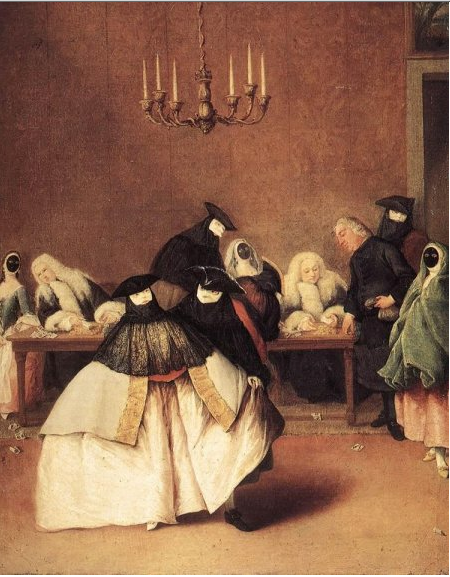
Venetians of the 18th century wearing bautas and morettas during Carnival.
It’s nearly Mardi Gras already, so it’s high time that I gave a nod to the Venetian masquers of old, who eerily drift through Encyclopedia of the Exquisite. For over half the year, from early October through Lent, the nobles of that city wore masks during the early 1700s. Cloaked, hooded and capering around in their stark black and white masks, they bring otherworldly mystery to the city’s every day events, as depicted by those great Venetian artists Longhi, Guardi and Tiepolo.
The Doge demanded that the upper classes wear the black capelet and white half-mask combination called the buata—the sound used to scare little chidren, “bau, bau.” But some women donned the even more disturbing moretta mask, a black velvet disc held in place by a button clenched between the teeth. Their faces were like negative images. They were silent, lest they let the button slip. I with I could have been there to see it all.
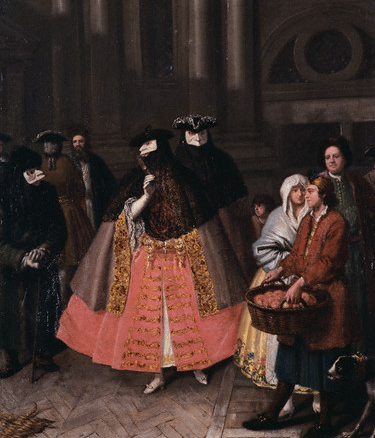
...in their bautas in the streets...

...maskers check out Clara the rhino....

...at the gambling table....
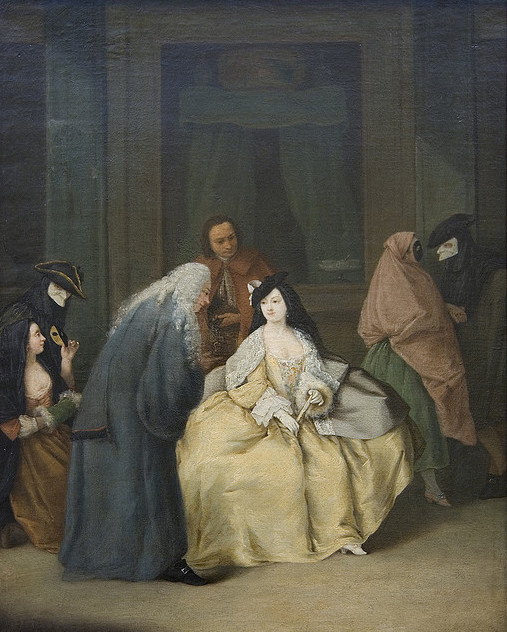
...and on it goes. I love the woman at the left who has removed her moretta. Ahhhhh....


Strange and slightly grotesque but still eerily beautiful. I wish I could have been there too.
Love reading your posts but here are a few tidbits of Venetian history that are a friendly correction. The buata was just the cape, not the mask. The white mask was the larva. Its widened lip area allowed the wearer to eat and drink. It also altered the sound of the voice, so it was a dually good disguise. The doge did not force people to be masked, but rather, decreed when they could not wear them, which was most of the time. His intention was to discourage unsavory behavior. People were getting away with murder (literally) and other not so nice things while incognito.
How interesting! I had read that the buata was specifically the Venetian mask-and-cape combination, and that the doge decreed the nobility should go masked that way so that they would be easily recognizable as such, and wouldn’t be bothered by the commoners. It certainly does sound like strange times in a strange and beautiful city. Thanks for writing.
Best wishes,
Jessica
Agreed! It’s right on the attraction/repulsion borderline….